Evaluation by Narration

Narration can be a tool to provide context and perspective to a concept. An example was provided in the drawing of a snake that had swallowed an elephant from the book “The little prince”. Most would say they see a picture of a hat, but through narration we can shift the focus to seeing it as a snake. An other example would be picture of the Rabbit-Duck, as made famous by Ludwig Wittgenstein. Storytelling can complement an existing image.

Exploratory play, Filtering and Media Archeology are three related methods. Exploratory play is the method of deconstucting story lines and rearranging the single elements. This can be used to find new inspirations, and is especially useful in future based design. Filtering describes putting a prototype into a situation to see if the outcome would be coherent. Media Archeology is based on the fact that, especially with planned obsolescence, disposed media products are omniresent, and these can be used to be reconfigure and experimented upon. Exemplary for this would be the process of circuit bending, used most in combination with music, where the circuits of often broken toys and gadgets are manipulated, short circuited and exploited in order to create new, often unpredictable results.

Storytelling can be important for selling ones Idea. In a corporate environment it’s important to recognise elements such as strategies, the politics within a system, corporate culture and the emotions of the individuals. Depending on where one places an argument and how prople are approached it can have varying results.

In a wider picture, it is important to remember though that presenting a narrative can have negative effects, especially when a story starts to replace the actual product. Generally, we live in an extensively mediatised and medialised society. The narrative is often a core component, even in fields traditionally distanced from media. This created a landscape that can be treacherous to navigate, and lines between complementing stories and straight up misleading content can be blurry.

New perspectives can also be found via tactics such as constructing alternate presents and speculative futures, asking quite simply “What if?”. The resulting oddness of a scenario can be enlightening to situations in our reality. Resulting material and prototypes are useful to present to professionals as also the general public, as they mostly play off peoples needs and desires. For instance, spaceX sells a potential future of space exploration, using what are basically large scale prototypes to spread their message.

I see a certain potential also in looking at complete utopias, and from there starting to base them in reality, approaching a narrative from the other end as opposed to starting with a product and then hyperbolically constructing a story how it could save us all.
The question of the prototype

Prototyping can be seen as a distillation of a single design element, which is pronounced, in a prototype, as others are kept to the side.
These can be used to further inspiration, to communicate to others in a working group, to user test, secure funding etc.
Here in lies one danger, that if one shows a working prototype to an external participant, it has to be clear, which element of the design is being tested, else all the feedback one gets might be for an unrelated part.

The process is not only to develop concepts and create prototypes as representations, but to integrate inspirations born from the creation of prototypes. This can happen throughout the design process, testing components by oneself or by users, preferably already early on, as soon as one can show a minimal viable interaction one can infer whether ones concept is engaging. This can take shape for instance using physical computing, not as a computer per se but as a bridge between conception and the physical world, or using proofs of concepts, for instance narratives or videos.

Prototypes can vary especially concerning their resolution and feedback time. Next to making sure one is testing the right thing, one has to differentiate between testing and convincing people. Looking further, we can use prototyping to look at sustainibility, costs, safety or similar notions, and at some point one has to evaluate whether one is comfortable to procede to executing an idea, or if one stays in the potentially self sufficient cycle of prototyping.

The experience and the user-experience

The experience and the user-experience

The Experience is the product

You push the button, we do the rest! – Kodak, and the development of consumer camera technology can be seen as an example for how not just technology, but also the surrounding experience can be seen as a product. The simplicity afforded by a system taking care of development and setup of photographs allowed a wider audience to utilise photography and enabled it to be a more lifestyle-oriented practice, as opposed to a past time for the «geek». Similarly, the Ipod represented a shift to a design encompassing buying, managing music with the ITunes software and store and created an easy to use, if closed off environment.

Personally, I have noticed a preference towards the more open, “tool-like” approach to design. For instance, I remember the fact that the Ipod was part of this whole environment and that it necessed operating within it’s structure as a central reason I didn’t buy one. Of course this is looking way back by now, and was based also on other biases I held, but still I tend to dislike it when a product seems to suggest too much, how it should be used, and by extension, how I should live.

Looking a bit further, Social Media presents an interesting field of research, both concerning the interactions with the programs and between users. The experience of using social media can vary strongly, especially since some sites are geared towards creating an online persona, using media such as photos to construct an image and gain exposure with is then rewarded through the likes of likes or followers. Other platforms deny the possibility to construct this image, focussing more on discussion, anonymity, with both ones audience and opposite being unknown. The responses are more direct and the accumulative effect lessend. Going even further, some basically resemble shouting into a void.

Human-Computer Interaction and methods

The growing complexity of systems we deal with lead to a need for a new way of analysing the needs of users. For example, urban planning can be coupled with a process of co-designing with residents and other users of a space.

One interesting model for a design process is taken from the Interaction Design Sketchbook by Bill Verplank, it postulates methods of approaching a design problem from either an idea, a metaphor, model, display, error, scenario,task or control. All of these are eventually played through, but they offer differing conclusions.

One central concept is the differentiation of path knowledge and map knowledge. Path knowledge represents intuitive, simple causes and effects. If one presses a button and a light goes on, this can be recognized purely with our senses.
Map knowledge is more relevant in more complicated systems such as UI or OS designs. The user learns a map of the system, and can get to a goal using their own representation.
This also brings us to a useful paradigm of how a computer is perceived. It can take the form of a brain, a tool, or as media, depending on the use, and how the interaction is structured.

Week 1 – Deconstructing Interaction Design


In every design situation, even when taking into account all restrictions and limitations, there are still an unlimited number of possible visions and operating images. A design situation can never be restricted tot he extent that there is only one solution, because if that were the case, it is, by definition, not a design situation.


Löwgren, J. & Stolterman, E. (2007). Thoughtful Interaction Design. The Process

One question that sums up what I take away from this first lesson concerns the scope of a design process. While many roles in society play in a specified arena, be it the political, medial, or other, it could be argued that interaction design necessarily has to traverse multiple ones. By looking at the complex functions behind what constitutes an interface, we can potentially find answers in the languages of all the arenas at play in the situation.

It is important to consider the environment, the scale and the format one is working with. Depending on these an intervention could look very different, taking form as a structural change, an artistic component, a speaking toaster. Though possibly the key to a structural change would be to have the toaster spew ideological content.

Concerning art and design, fundamentally I see the artistic as almost a subset of the design method, though the artistic endeavour specifies a rejection of boundaries and parameters, acting more as a proposal or statement, exemplified in the narratives and guides science fiction presents.

When approaching a design situation whether concerning an interaction between people, between people and objects, or even between different objects we are confronted with a general choice; do we design the interaction, or merely observe it and facilitate it. We can either make users think the way we want them to or enable people to create their own use of a product. This continues into how a product is marketed, as generally the marketing will imply a certain lifestyle or context of its own. This continues throughout the life cycle of a project. If, for instance, we launch a social media site with an express purpose, e.g. keeping up with friends, and the platform is “misused” to organise political resistance, is this something we integrate or resist as it goes against the design vision.

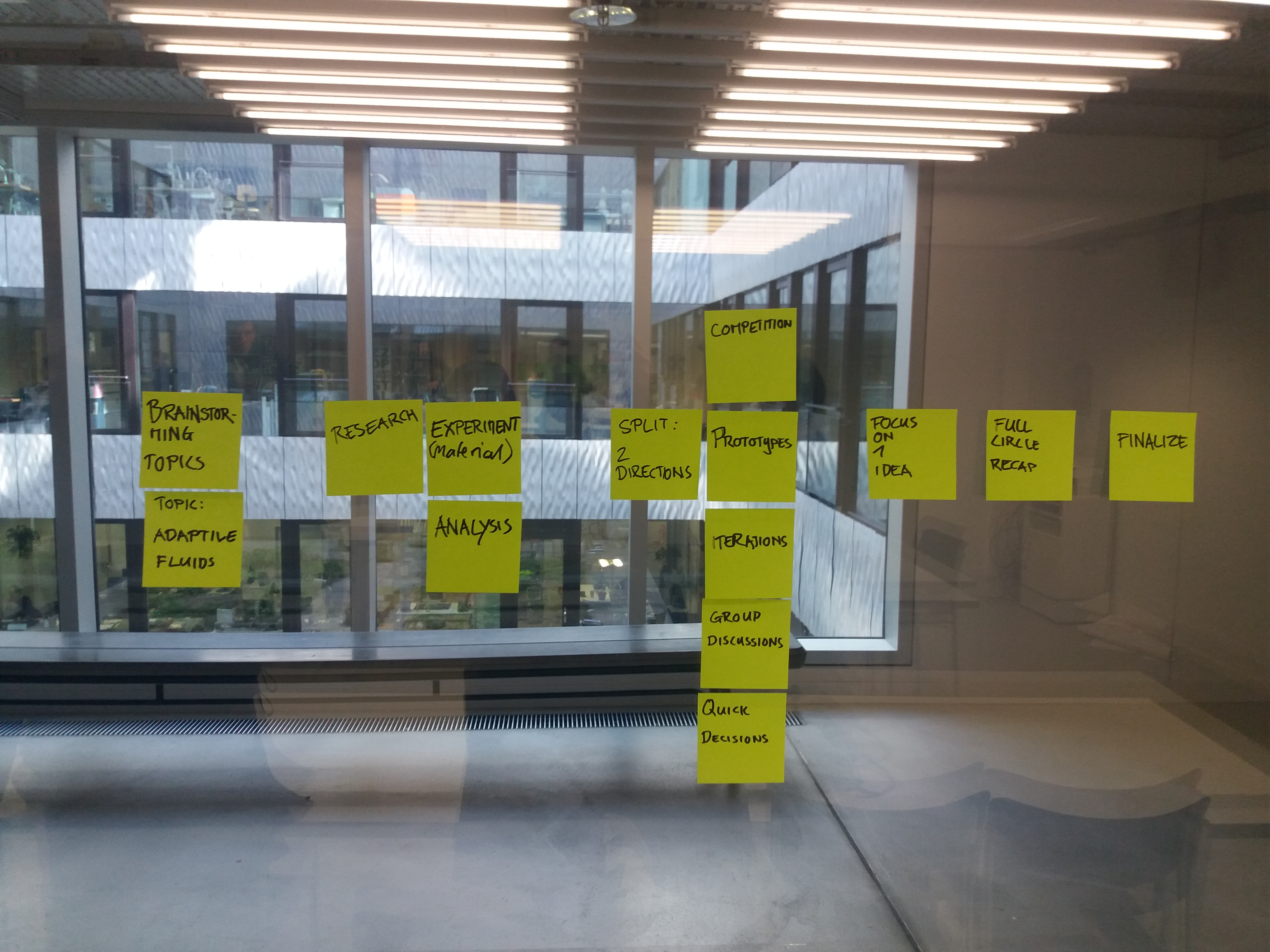
Looking at the process of a specific project, our contribution to the course “Digital Fabrication” earlier this year we see an interplay of defining the topic and potential solutions.